The Casing Tradeoff: Upfront Cost vs. Frac Efficiency
What Is Your Casing Really Costing You?
β
5.5-inch casing is often selected because it keeps upfront well costs lower, while moving to a larger diameter increases casing cost. But casing size also directly impacts pipe friction during the frac β influencing treating pressure, achievable rates, chemical usage, and stage efficiency. In this field comparison, the hydraulic benefits of 6-inch vertical casing translated to lower treating pressure, reduced FR loading, faster stage execution, and an estimated $20,000β$40,000 in savings per well.
β
A comparison between 5.5-inch and 6-inch vertical casing shows how an early well design decision can carry directly into frac performance and completion economics.
β’ ~4 bpm higher achievable rates
β
β’ ~170 psi lower treating pressure
β
β’ ~20% reduction in FR loading
β
β’ 5β10 minutes faster stage execution
Why Pipe Friction Matters During Execution
β
As pipe friction increases, more energy is lost before it ever reaches the perforations.
β
That loss must be compensated for β with higher pressure, more chemicals, and/or slower execution.
The challenge is that pipe friction isnβt directly measured in the field. Itβs typically estimated, which makes it difficult to quantify how much pressure is actually being lost.
β
Across this dataset, stages with 5.5-inch monobore casing consistently operated in a more constrained hydraulic environment. They ran closer to pressure limits, required higher chemical loading to maintain performance, and took longer to execute. These are all surface symptoms of the same underlying issue: higher pipe friction.
Measuring Pipe Friction in Real Time
β
SAFA changes that.
β
By measuring pipe friction in real time at the well, SAFA isolates how much of the treating pressure is being consumed by the wellbore versus delivered to the formation.
β
That separation is what makes it possible to clearly see the impact of casing design on execution.
β

Where the Difference Shows Up
β
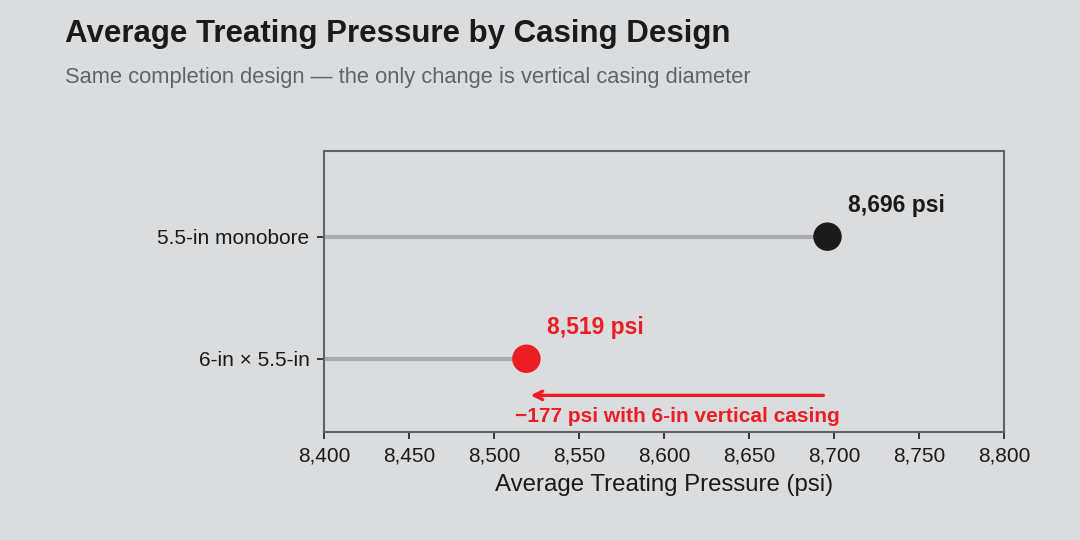
Increasing casing diameter to 6-inch in the vertical reduced friction through the system and created more operating flexibility. That showed up as:
β

β
β’ ~4 bpm higher achievable rates
β’ ~170 psi lower treating pressure
β’ ~20% reduction in FR loading
β’ 5β10 minutes faster stage execution
β
Nothing else in the completion design changed. The improvement came from reducing resistance in the system.
The Economic Tradeoff
β
Larger casing increases upfront cost, but it also changes the operating envelope of the frac.
β
In this case, the efficiency gains translated to:
β’ $500β$1,000 savings per stage
β’ $20,000β$40,000 per well
β
Along with:
β’ Lower chemical usage
β’ Reduced fuel consumption
β’ More efficient use of pumping horsepower
β’ Higher rates
β
Over a full well and pad, those gains offset the initial casing cost difference.


β
What This Means for Your Program
β
When treating pressure or rate limitations become recurring challenges, itβs often a sign that too much energy is being lost to friction in the system.
β
Understanding where that loss occurs is the first step toward improving efficiency.
β
With direct measurement of pipe friction, operators can:
β’ Quantify how much pressure is lost in the wellbore
β’ Evaluate design tradeoffs with real data
β’ Identify opportunities to improve execution across stages and wells
β
Schedule a technical review to evaluate whatβs driving your treating pressure β and where those losses can be reduced.
β