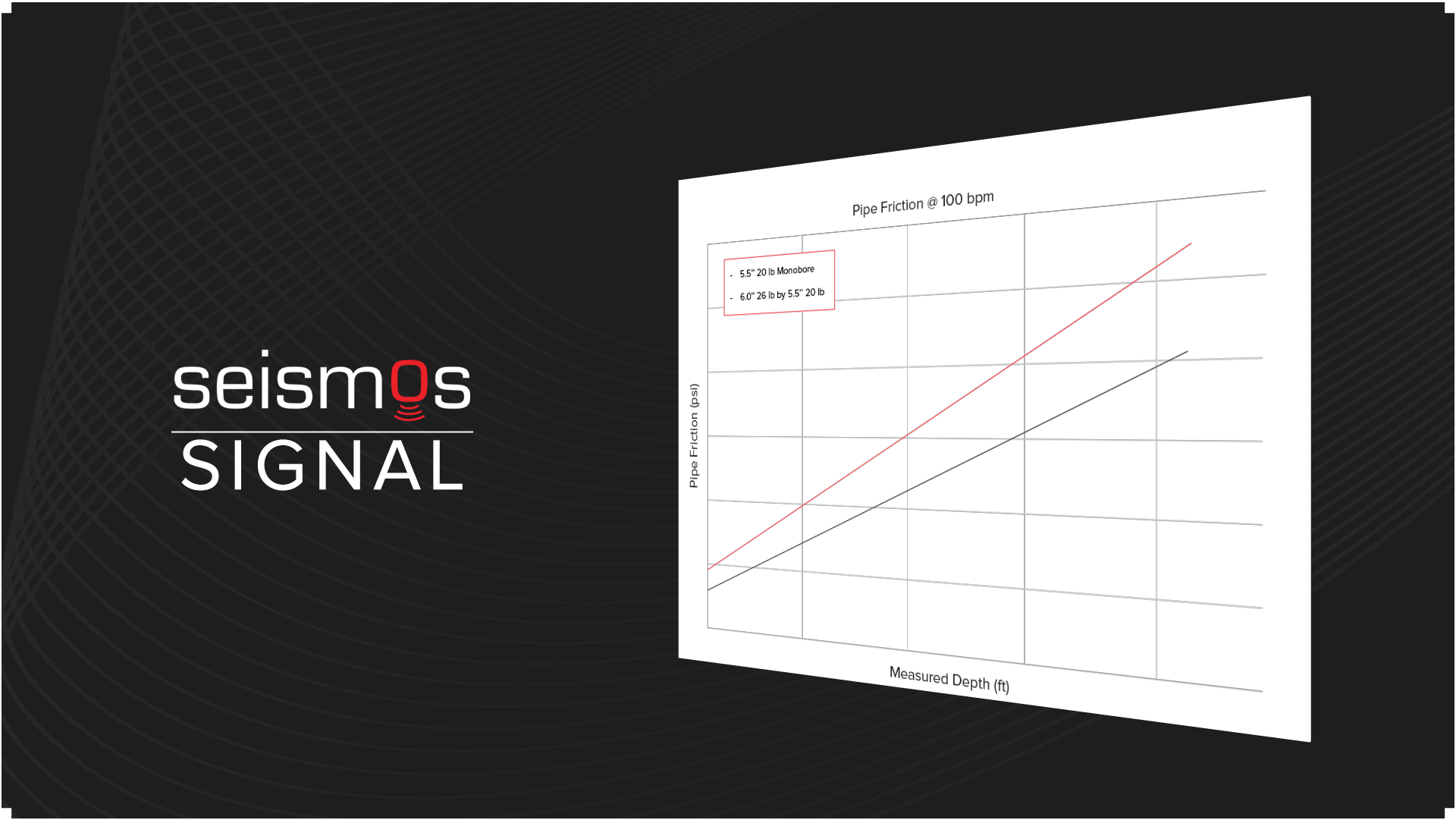
Real-Time Completion Logic from Same-Well Measurements
How Seismos Acoustic Friction Analysis (SAFA) supports scalable closed-loop fracturing workflows
Seismos Acoustic Friction Analysis (SAFA) closes that gap using high-frequency surface pressure data to separate pipe and perforation friction in real time.
From that separation, the system calculates perforation efficiency, Uniformity Index (UI), perforation diameter, and pipe-friction curves and streams them to a live dashboard for stage-by-stage decision support.
• SAFA delivers live perforation efficiency, UI, and hole diameter without requiring offset wells or downhole fiber.
• Decision criteria can be built around measured subsurface performance – not just treating-pressure events.
• Live diagnostics enable simple and repeatable interventions during pumping.
• Volume-neutral workflows redeploy fluid and proppant from poor stages to stronger stages without increasing total material.
Treating Pressure Does Not Reveal Downhole Distribution
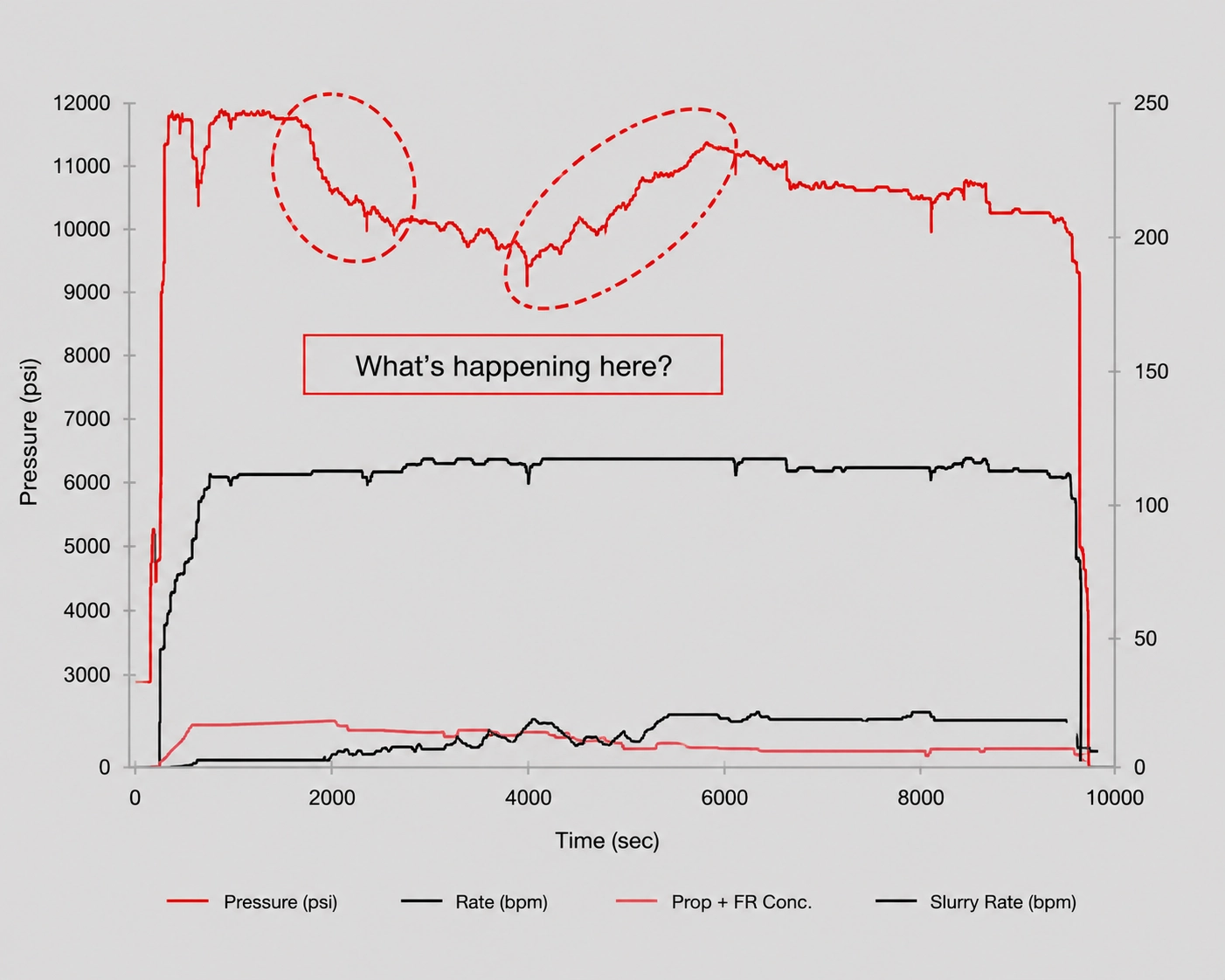
Treating pressure is the primary signal engineers watch during a frac job, but it is a convoluted response of pipe friction and perforation friction.
Pressure changes imply that something changed downhole, but not whether clusters are distributed evenly, perforations are dropping out, or near-wellbore conditions are degrading during the stage.
Fiber optics have proven the value of real-time subsurface feedback, but cost and complexity limit broad deployment.
Why Real-Time Cluster Metrics Matter
Live feedback of perforation efficiency and UI provides a direct read on stimulation effectiveness – showing both how many clusters are contributing and how evenly slurry is distributing across them.
Importantly, UI is not just a stage metric; it ties directly to outcomes. Field studies show that a 10% increase in UI correlates with ~7–12% more production in the Williston Basin and ~6–10% in the Permian, underscoring why uniform cluster contribution matters.
Real-time checks on total flow area also help flag unexpected changes consistent with plug or casing integrity issues that can become extremely costly and threaten ultimate well performance.
How SAFA Enables Real-Time Completion Logic
SAFA deployment requires minimal additional hardware at the wellsite: a high-frequency pressure transducer on a surface treating line and a data acquisition unit tied into the frac data stream.
The software continuously monitors pressure and rate and automatically triggers analysis when it detects a rate-change event.
Planned analysis points are introduced by briefly changing the pumping rate early in the stage, mid-stage, and near stage end. Each event updates the live metrics within seconds and logs a traceable snapshot of near-wellbore performance.
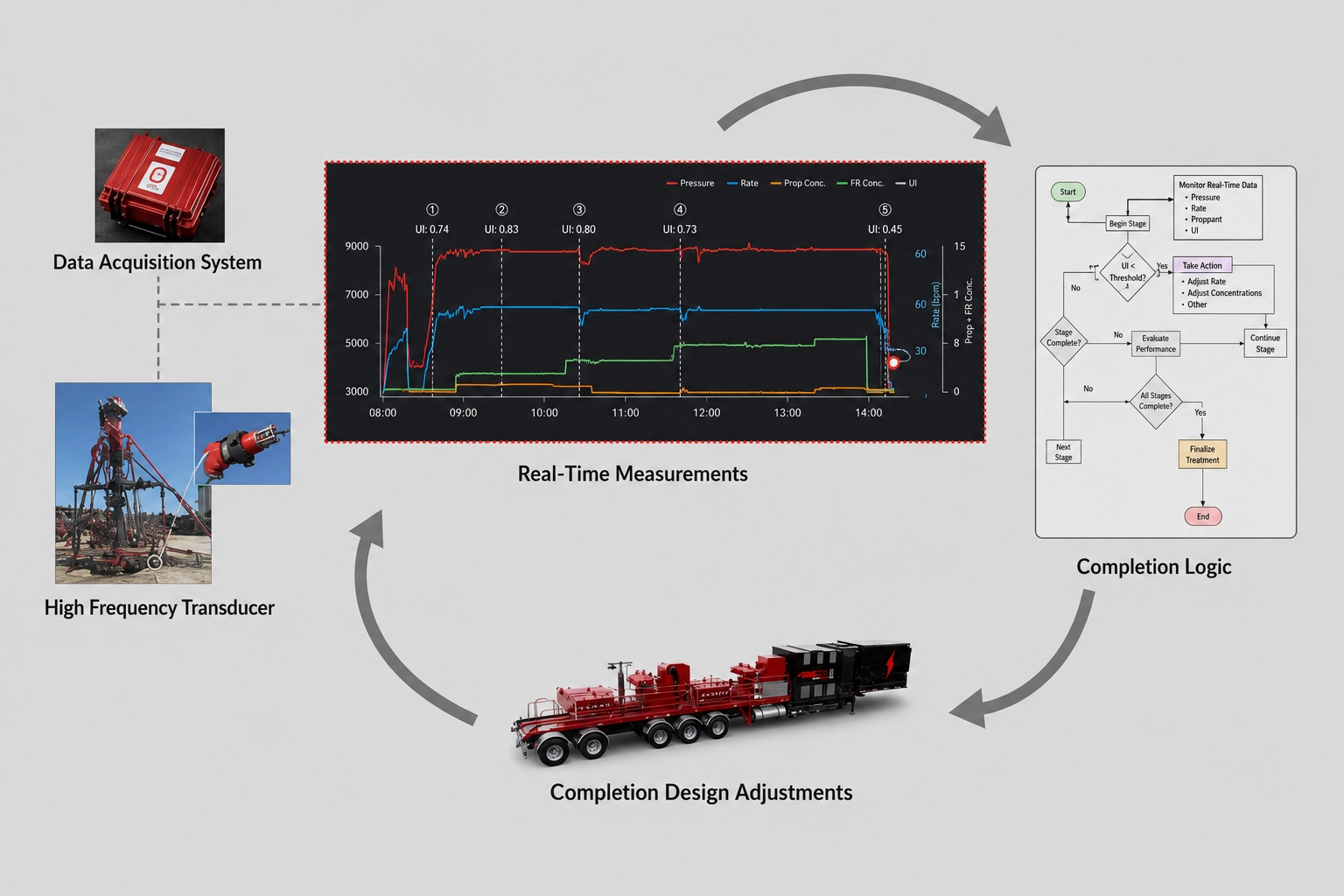
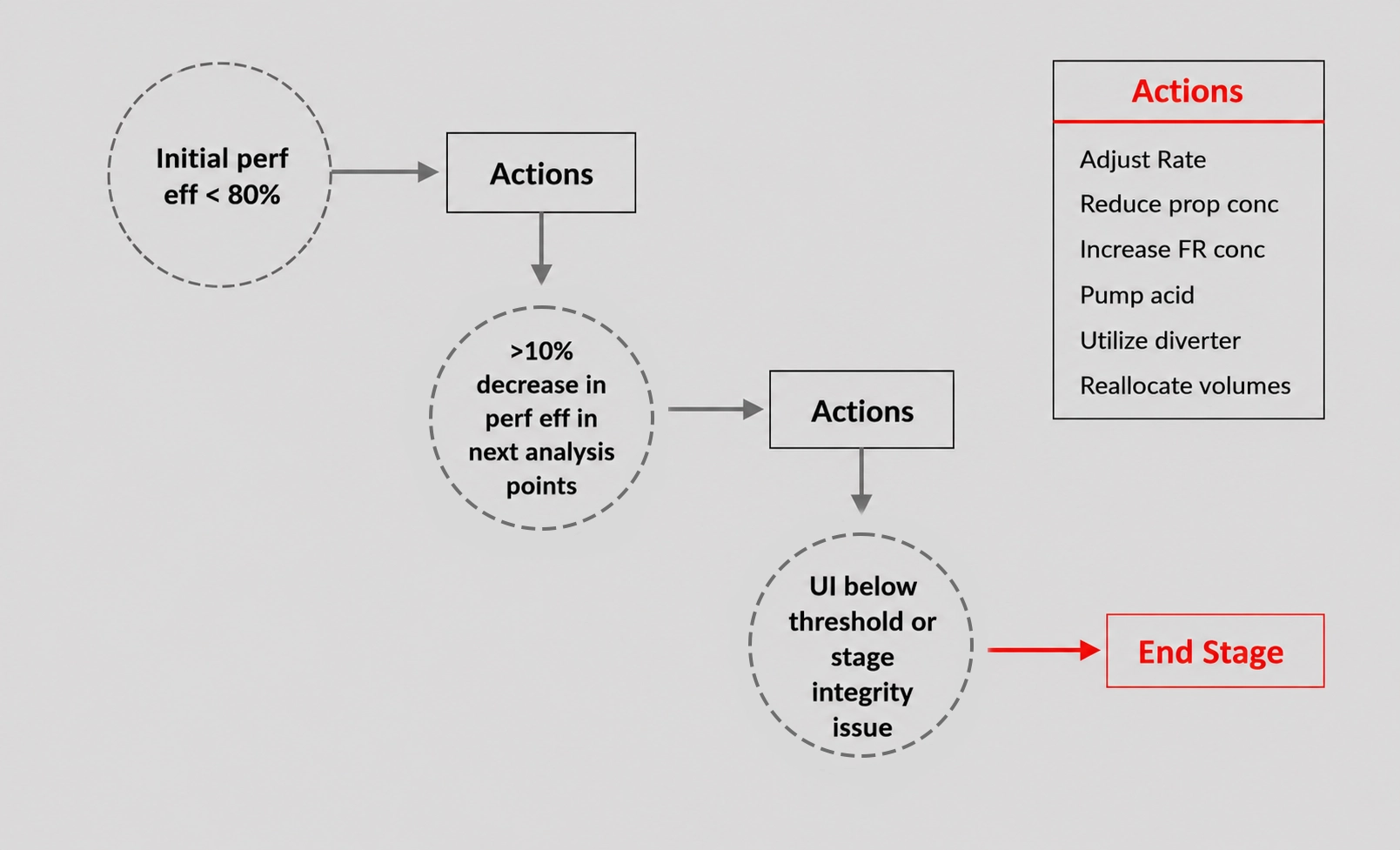
Those snapshots are connected to a configurable decision tree. The workflow starts with an initial efficiency check, re-evaluates trends mid-stage (especially as slurry conditions change), and governs end-of-stage actions (continue, optimize, stabilize, or exit).
The ultimate objective is repeatability: consistent decision-making criteria leading to actions grounded in same-well measurements.
Operational Examples During Pumping
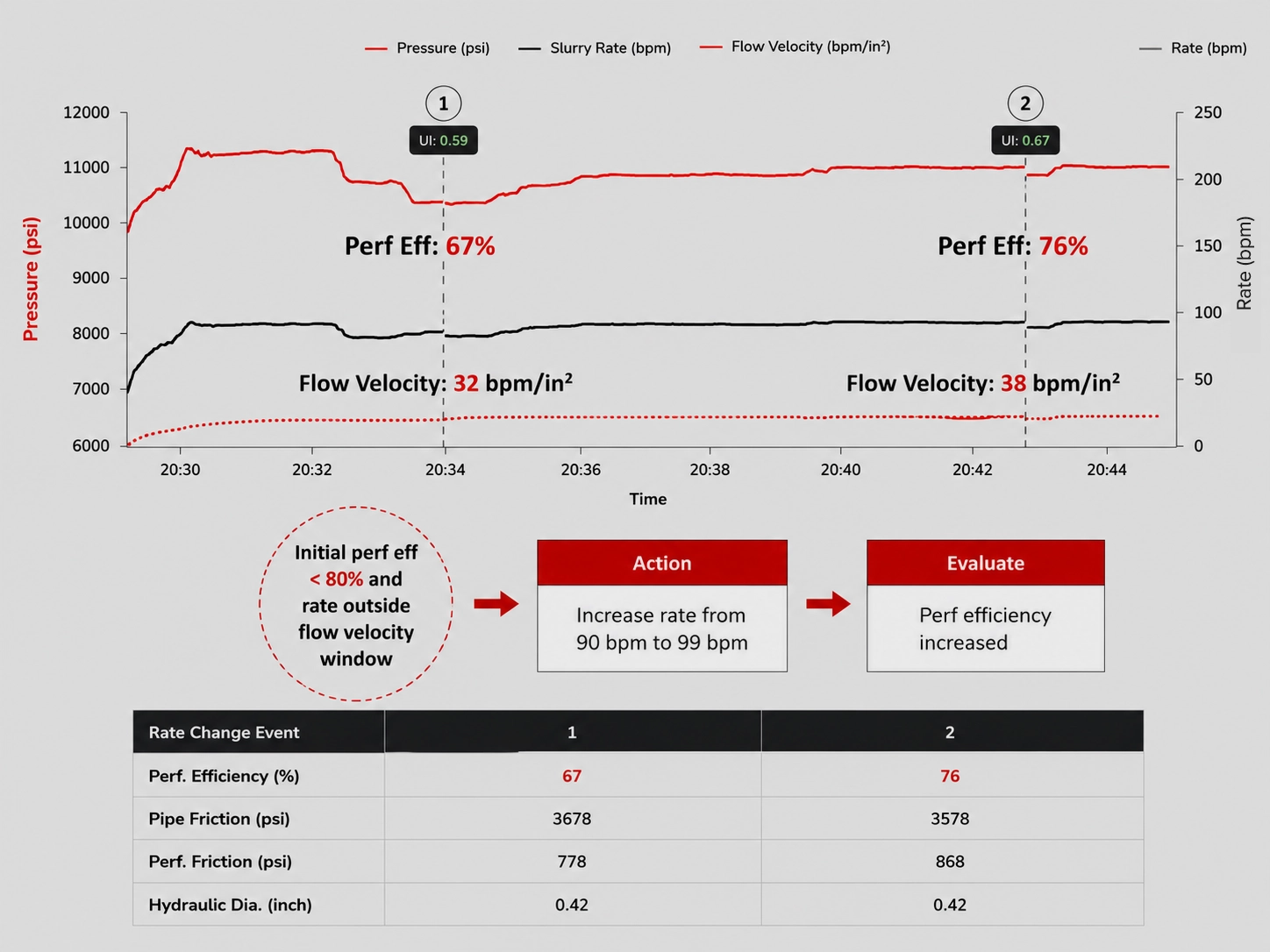
Flow-velocity tuning: Each formation exhibits a flow-velocity window where cluster contribution and uniformity are maximized. Because metrics are calculated live, rate can be tuned to stay in the optimal band. One example increased rate from 90 to 99 bpm (flow velocity ~32 to ~38 bpm/in²) and improved perforation efficiency from 67% to 76%.
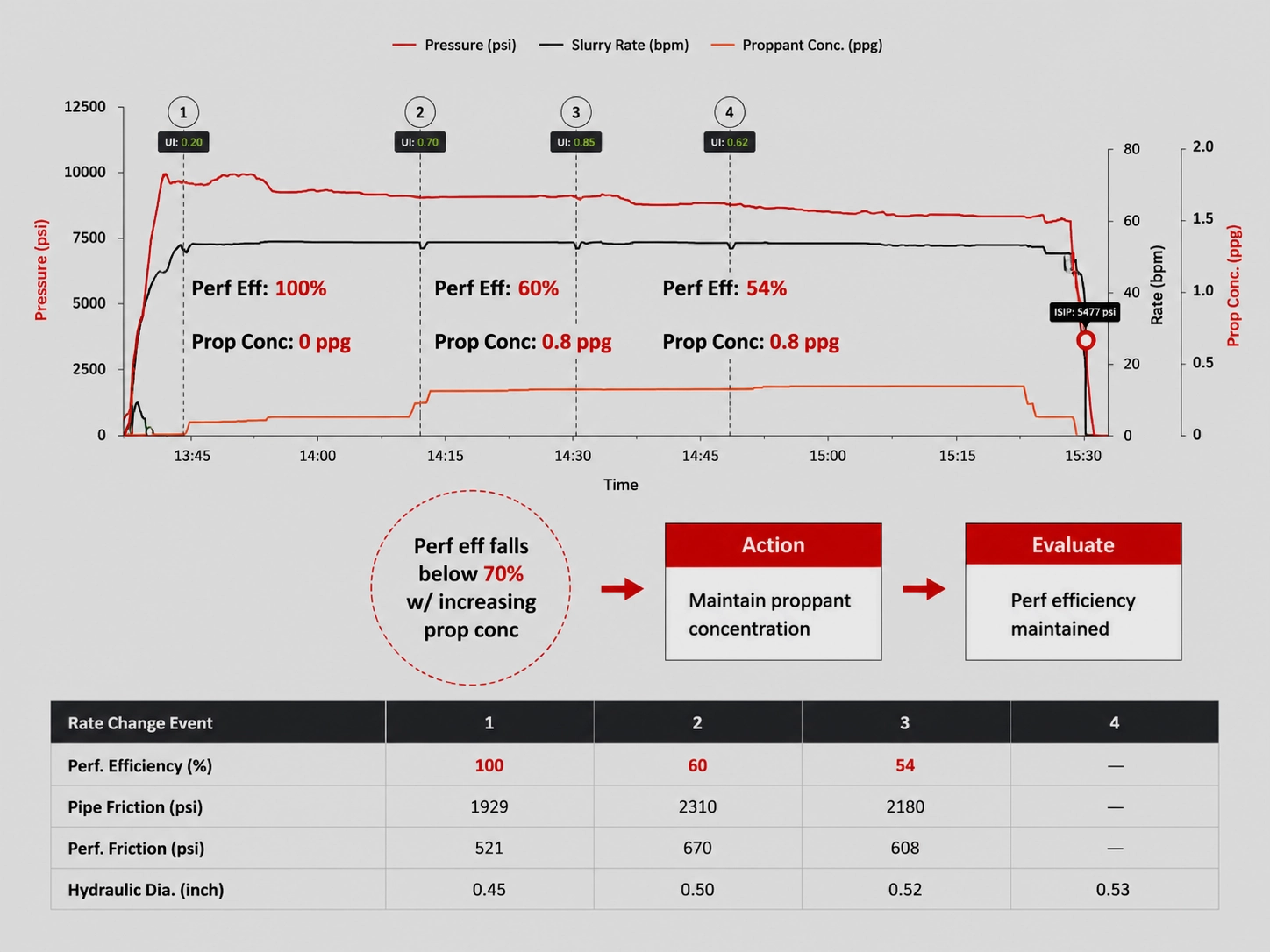
Adaptive proppant ramps: Across a pad dataset, perforation efficiency declined as proppant concentration increased, with stable performance above 90% up to ~0.8 ppg and wider variability once concentrations exceeded ~1.0 ppg. Live monitoring enables an immediate response: pause or smooth a steep ramp when efficiency collapses, then resume once distribution stabilizes.
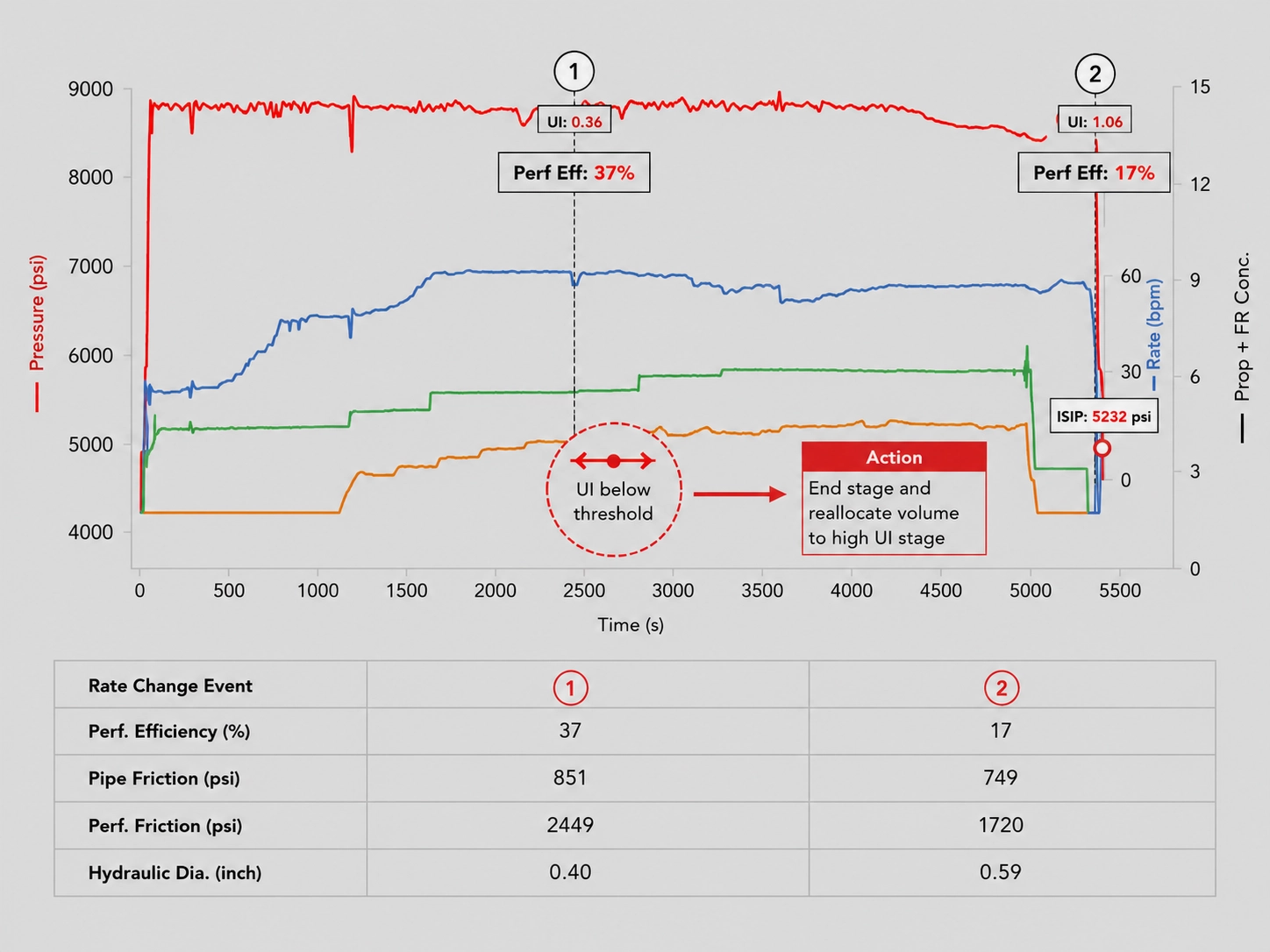
Volume-neutral reallocation: When UI falls below a defined threshold, continuing to pump can concentrate proppant into runaway fractures. With live monitoring, low-performing stages can be curtailed intentionally, with remaining slurry redeployed to later stages that demonstrate stronger distribution. Total fluid and proppant for the well are unchanged, and capital is deployed more effectively across the lateral.
From Supervised Decisions to Closed-Loop Control at Scale
Closed-loop fracturing is best viewed as a control framework: measure downhole response, classify the condition, and execute an action.
Supervised treatments use the live dashboard to guide human interventions, while unsupervised methods convert the same criteria into automated control actions triggered directly by the measured response.
Closed-loop execution is already being applied in both supervised and unsupervised modes, driven by real-time, same-well measurements that scale across development programs. With this foundation, SAFA enables a new era of data-driven, adaptive fracturing – where every stage is monitored and improved in real time.
Ready to Evaluate Real-Time Stage Quality in Your Program?
Schedule a technical review to learn how same-well measurements can support repeatable, real-time stage decisions. Our team can help you:
• Define thresholds for perforation efficiency, UI, and casing or plug integrity issues.
• Identify formation-specific flow-velocity windows and rate targets.
• Implement proppant and volume-reallocation logic that remains volume-neutral.
• Operationalize supervised closed-loop workflows at scale.